
Crypto, explained simply

Meet Seismic — the chain that keeps secrets

A new kind of blockchain where your data can stay encrypted by default — even while it's being used. Here's what that means, in plain English.

Start here

Most blockchains are made of glass

On Ethereum and almost every public chain, everything is visible forever: your balance, every trade, every message. That openness is powerful — but it also means anyone can watch what you hold and what you do. Imagine your bank statement printed on a billboard, permanently.

A normal public chain
  • Anyone can see your balance
  • Every trade is public, forever
  • Bots can front-run your moves
Seismic
  • Balances can be private by default
  • Inputs are encrypted before they're sent
  • Data stays sealed even while computing
The basics

So, what is Seismic?

Seismic is a Layer 1 blockchain (its own base network, like Ethereum) that builds encryption right into the protocol. It's EVM-compatible — it runs the same kind of smart contracts and uses the same developer tools as Ethereum — but data can be private by default. The simplest way to think about it: Ethereum, with a privacy layer baked in instead of bolted on.

Private by default

Sensitive data is encrypted at the protocol level, not patched in at the wallet.

EVM-compatible

Write Solidity, deploy with Foundry, use Viem — the tools Ethereum devs already know.

Hardware-secured

Every node runs inside secure hardware (a TEE) that can compute on data without exposing it.

How it works

Three ways Seismic keeps things private

The hard part is doing useful work on data without ever revealing it. Here's how Seismic pulls that off — with a short animation for each idea.

01

Encrypted execution

Smart contracts run inside a Trusted Execution Environment (TEE) — a sealed, tamper-proof region of hardware. Your inputs are encrypted on the way in and stay encrypted while the contract computes on them.

In plain EnglishThe computer runs your transaction inside a locked box. It can do the math without ever seeing your secrets in the clear — not even the operator can peek.
02

Encrypted global state

Apps don't live in silos — they share one global state. On Seismic that shared state stays encrypted end-to-end, so apps can still work together while the data between them stays hidden from outsiders.

In plain EnglishDifferent apps can still talk to each other, but the information passing between them stays scrambled to everyone else.
03

Private memory access

Developers can mark specific data as private. Balances, order books and business logic get computed on-chain without ever being published for the world to see.

In plain EnglishBuilders simply tag what should stay secret, and the chain keeps it that way — no cryptography degree required.
Under the hood

The tech, simplified

You don't need this to use Seismic — but if you're curious, here's the real machinery, with what each piece means for you.

suint · sbool · saddress
Shielded types. Normal Solidity has uint; Seismic adds encrypted “s” versions. Developers barely change their code to make data private.
ECDH + AES-GCM
Client-side encryption. Your transaction is locked on your own device before it's sent. Only the network's secure nodes can open it.
TEE, not ZK
Trusted hardware. Privacy comes from every node running inside a secure enclave — a different design choice than zero-knowledge proofs, optimised for speed and familiar tooling.
seismic-reth · Mercury
A shielded engine. Seismic's node is a fork of Reth that splits memory into private and public regions, with new opcodes (CLOAD / CSTORE) for encrypted storage.
Solidity · Foundry · Viem
Still just Ethereum tooling. If you can build on Ethereum, you can build on Seismic — same languages, same workflow.
// On most chains, this balance is public:
uint256 balance;

// On Seismic, one letter keeps it encrypted:
suint256 balance;   // stays private, on-chain
Why it matters

What you can build with privacy

Confidential DeFi

Trade and lend without broadcasting your positions for bots to exploit.

Sealed-bid auctions

Bids stay hidden until they close — no sniping, no front-running.

Private payments

Salaries, invoices and transfers that don't expose your finances to everyone.

Games that don't leak

Hidden moves, fog-of-war and secret state — finally possible on-chain.

Fintech & compliance

Meet data-privacy rules while still settling on a public network.

Encrypt all chains

Seismic's mission: make privacy the default across Web3, not the exception.

The money

Who's backing Seismic?

Seismic has raised $17M across two rounds — both led by a16z crypto, one of the most respected funds in the space.

$17M
Total raised
2
Rounds, both a16z-led
2025
Seed + follow-on
Mar 2025
$7M seed
Led by a16z crypto · with Polychain, 1kx and others
Nov 2025
$10M round
Led by a16z crypto · with Amber Group, Polychain, TrueBridge, dao5, LayerZero
a16z cryptoPolychain1kx Amber GroupTrueBridgedao5LayerZero
The builders

The people behind it

Lyron Co Ting KehLK

Lyron Co Ting Keh

Founder

Stanford CS & Math. Previously built privacy tooling for Zcash and Aztec, and founded an edtech company before Seismic.

Peter HePH

Peter He

Core engineer

Led Ethereum application-chain frameworks; specialises in distributed systems and privacy technology — driving Seismic's implementation.

The wider team includes engineers and operators with experience from Wintermute, Google X and Apple R&D — a mix of crypto-native and deep-tech backgrounds.
Newbie glossary

Words you'll see, decoded

Layer 1 (L1)

A base blockchain that runs and secures itself, like Ethereum or Bitcoin — as opposed to a Layer 2 that sits on top of one. Seismic is its own L1.

EVM

The Ethereum Virtual Machine — the “engine” that runs smart contracts. EVM-compatible means Ethereum apps and tools work with little to no changes.

TEE (Trusted Execution Environment)

A locked, tamper-resistant area inside a computer's chip. Code and data inside it are hidden even from the machine's owner — Seismic uses TEEs to compute on encrypted data.

Shielded types

Encrypted versions of normal data types (suint, sbool, saddress). Mark a value as shielded and it stays private on-chain.

Calldata

The input you send along with a transaction. On Seismic it's encrypted on your device first, so only secure nodes can read it.

Front-running

When a bot sees your pending transaction and jumps ahead of it to profit. Encrypting inputs makes this much harder.

Prove it

Get Seismic 101 certified

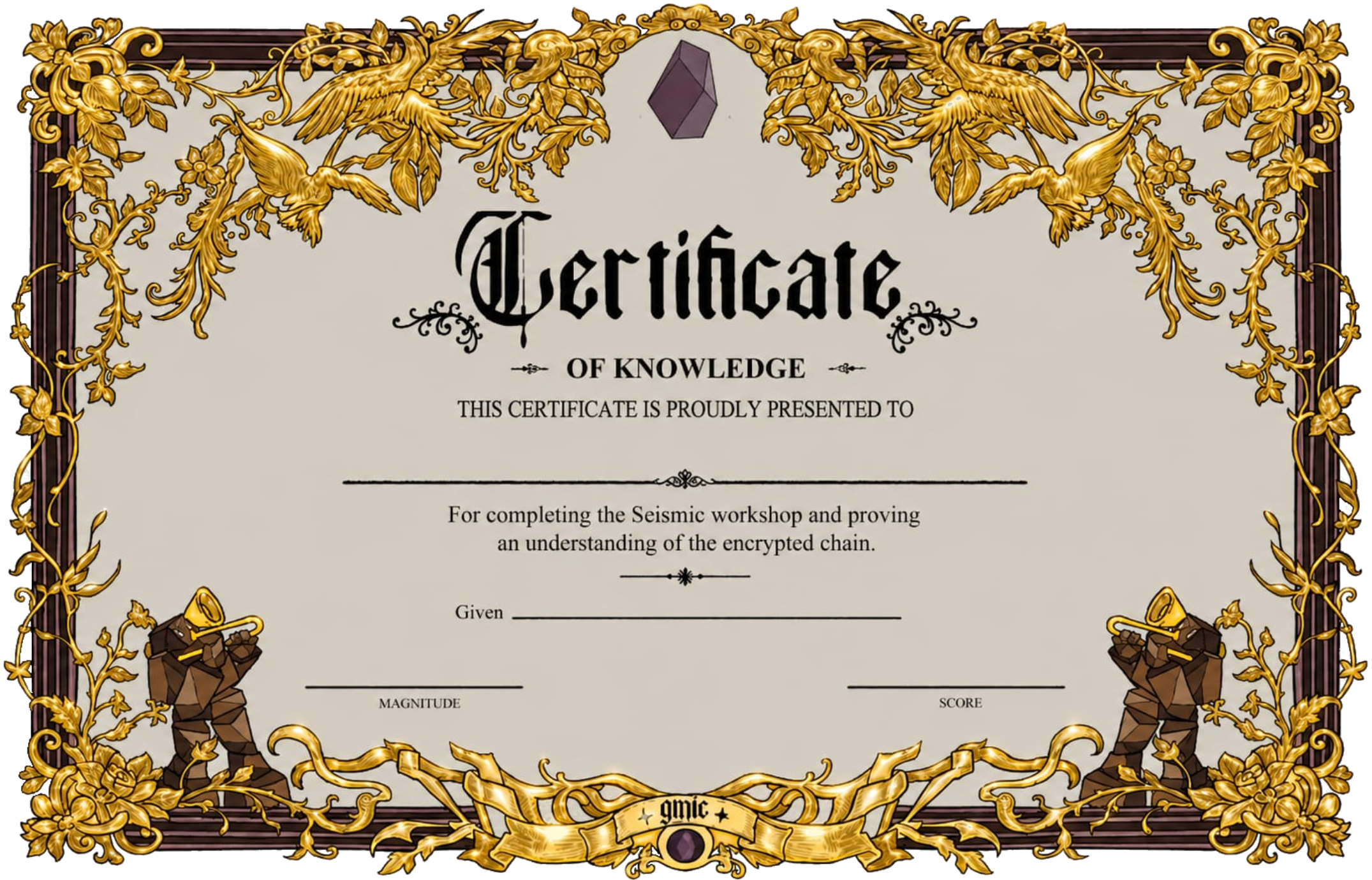
Think the encrypted chain finally clicked? Pass the 8-question exam, verify you're in the Seismic Discord, and claim a personalized Certificate of Knowledge — yours to download and share.

8 questions · pulled at random Pass mark 7 / 8 Discord-verified